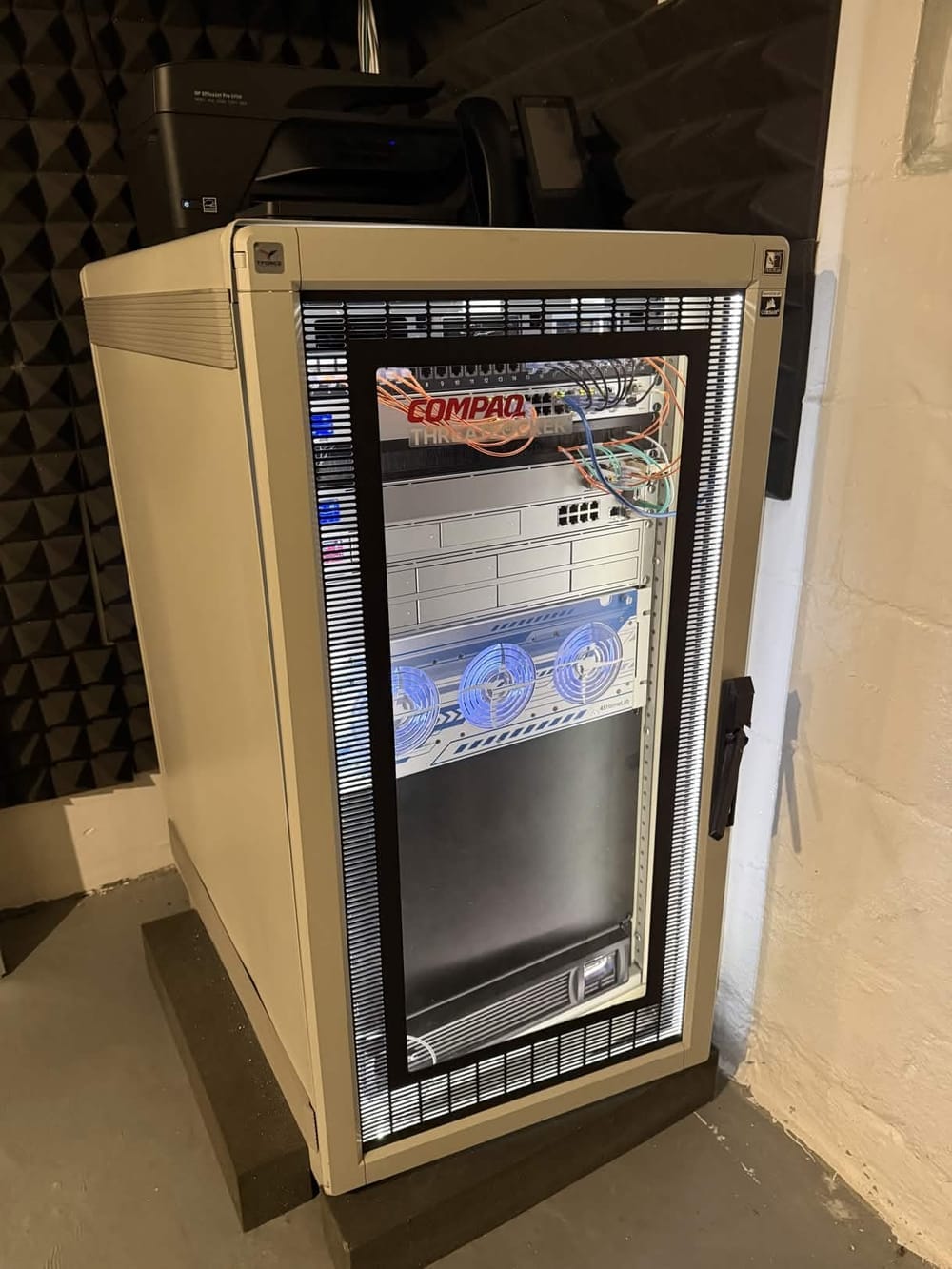

echo "HELLO WORLD"My name is Max Kulik. I currently serve as an IT Leader and Business Technology Consultant, but my foundation in this field was built long before my professional career began.
Building my Curiosity Driven Foundation
I grew up with a drive to get my hands on any piece of technology I could find, driven by a desire to understand the "why" behind the "how." This curiosity led me to my first major project: a 32-bit rack server running CentOS. While it provided my first introduction to Linux, it also provided my first real technical challenge.
As that architecture became obsolete, I found myself at a crossroads: I could either move on, or I could learn why it was failing. I chose the latter. This sparked a deep dive into computer science and hardware architecture, leading me to spend years deconstructing and rebuilding systems to understand exactly how components interact to create performance. I wasn't just building servers; I was teaching myself the first principles of computing.
With a growing collection of hardware and a foundational understanding of how it worked, I eventually faced the quintessential home-lab question: "Now that I have the infrastructure, what do I actually run on it?"
Being mindful of a tight budget, expensive proprietary operating systems weren't an option. This led me back to my early experiences with CentOS and a deeper dive into the open-source world. I began deploying servers with a level of intensity that can only be described as a total obsession. I started small, hosting basic web pages, but quickly scaled up to running multiple game servers for my friends and contributing my compute power to the early Folding@home community.
As the number of applications grew and my environment became more complex, I hit a new ceiling. I was no longer just wondering what to run, I was beginning to realize that I needed a more sophisticated way to manage it all.
Building a Lab and Exploring Virtualization
My search for a better management solution led me to the world of hypervisors and virtual environments. The first one I encountered was VMware’s ESXi, and at the time, it felt like magic. The ability to run dozens of isolated applications on the same piece of hardware simultaneously was the exact solution I had been looking for.
By the time I was in high school, I was spending my nights immersed in experimentation. I remember going through Distro Watch like a checklist. I downloaded every Linux ISO I could find, uploading them to my server, and spinning up VMs just to see how they differed. It was during one of these deep dives that I accidentally downloaded Proxmox.
I had expected another Linux distribution, but instead, I found an open-source, Debian-based hypervisor platform. I was immediately blown away. Without hesitation, I flashed the ISO to a drive and overwrote my ESXi installation, eager to master a new platform that aligned with my preference for open-source flexibility.
While my server continued to serve as a personal lab, the trajectory of my career shifted during a chance encounter in a high school classroom. While I was working in a Linux terminal, a teacher noticed my work and asked for an explanation of what I was building.
Pivoting From Hobbyist to Professional
In that moment, I unknowingly began developing one of the most critical skills of my professional life: the ability to bridge the gap between deep technical execution and non-technical understanding. This ability to communicate complex systems clearly caught the attention of the school district's Technology Director.
This connection led to an invitation to participate in a technology conference hosted by Paragon Development Systems (PDS), a leader in custom server architecture for companies like HP. This experience served as my bridge from the world of home-labbing to the professional technology sector, introducing me to the scale and complexity of enterprise-level infrastructure.
Unknowingly, I was beginning to build a network that would define my early career. Through a series of serendipitous introductions, including a connection to a Technology Director at HP, I found myself in rooms with some of the industry's most influential figures, from Malcolm Gladwell to the Chief Solutions Architect at PDS. The architects and engineers at PDS were impressed by the complexity of the projects I was managing at such a young age. This led to an extraordinary invitation: the opportunity to work one-on-one in their Development Lab in Madison, Wisconsin. For two summers, I had unprecedented access to enterprise-grade virtual environments, where I shifted my focus from home-labbing to the realities of large-scale computing.
This experience was a catalyst for my growth, providing me with a professional foundation that most don't encounter until well into their careers. Upon graduating high school, as my time in the lab came to a close, I found myself at a crossroads, ready to decide which professional path to pursue.
It's not What you Know ...
After high school, I was offered a role at PDS, but due to the distance and my current commitments, I had to respectfully decline. For a few years, I focused on the independence of early adulthood. Navigating the milestones of first cars and moving out, while keeping my home lab alive in the background. I also began taking on freelance web development projects, hosting sites and learning the business side of technology.
Then, the pandemic hit. While many found the era unsettling, it provided me with a unique opportunity. At the time, I had been exploring the world of streaming, which provided a stable income stream and, more importantly, a vast amount of free time. I decided to double down on my education. I shifted my focus toward Windows network management and corporate IT infrastructure, treating my home lab as a full-time classroom to ensure I could provide enterprise-level value.
I began documenting my journey on social media and launched a website offering IT services to small businesses. The response was immediate; within a month, I was managing a steady stream of gigs, solving technical hurdles for individuals and local companies.
Despite lacking a formal IT degree, I spent a year aggressively networking and showcasing my portfolio of home-lab projects and freelance successes. That persistence paid off when I landed a part-time technology consultation role with a public accounting firm with 11 locations. My impact there was felt quickly; within a year, the firm brought me on full-time as their Lead System Administrator, trusting me to manage their entire infrastructure and spearhead a massive cloud migration project.
Building Skills, Navigating Enterprise IT, Becoming a Leader
My time with the accounting firm was more than just a job; it was a catalyst for my professional growth and a massive expansion of my network. Although my role was internal, the trust I built with my colleagues created an unexpected referral engine. As they interacted with clients who were struggling with their own technology, they began recommending me as a trusted expert for on-demand IT support.
Before I knew it, I had built a substantial roster of independent clients. I recognized a significant opportunity here: there was a demand for high-quality, managed IT services that were accessible and efficient. I began researching the Managed Service Provider (MSP) model, looking for ways to provide enterprise-level stability and security without the bloated costs of traditional providers.
I spent my free time architecting a "lean" MSP stack. By combining a professional website with open-source ticketing, RMM, and AV/XDR threat management—paired with high-performance hardware and cost-effective backup solutions—I built a system that was both powerful and scalable. With my technical foundation in place, I shifted my focus toward business development, reaching out to my network to offer these managed solutions. To date, that venture has grown into a successful practice with multiple managed clients and my first employee.
As the major technology initiatives at the accounting firm reached completion, I began seeking a new challenge that would allow me to apply my skills on an even larger scale. This led me to Bell Ambulance, the largest private EMS company in Wisconsin, where I managed the technical needs of a workforce of 800 employees. Operating in a high-stakes, mission-critical environment like EMS further refined my ability to maintain stability and performance under pressure.
Today, I serve as the IT Manager for Bartolotta Restaurants, a Milwaukee staple known for culinary excellence. In this role, I combine my lifelong passion for technical architecture with strategic leadership to ensure the technology powering one of the city's most prestigious brands is as seamless and refined as the guest experience.
Whether I am managing a corporate network, scaling an MSP, or diving back into a home-lab project, I remain driven by the same curiosity that started it all. I believe that the best technical leaders never stop being students, and I bring that mindset to every project and partnership I undertake.